


Jesus, The Good Shepherd
Scripture quotations are from the EasyEnglish Bible Copyright © MissionAssist 2018, 2024 – UK Charitable Incorporated Organisation 1162807. Used by permission. All rights reserved. www.easyenglish.bible
John 10: 1-18
1 Jesus then said, ‘I tell you this. A shepherd keeps his sheep in a safe place with a wall around it. There is a gate into that safe place. Anyone who gets into that place by another way, not through the gate, is not the shepherd. That person is a robber. He comes to take away the sheep for himself.
2 But the shepherd goes in through the gate.
3 The person who watches the gate opens it for the shepherd. The sheep recognise the shepherd's voice. He calls each of his own sheep by their name and he leads them out.
4 When he has brought out all his own sheep, he goes in front of them. The sheep follow him because they know his voice.
5 They will not follow a stranger. They will run away from a stranger because they do not recognise his voice.’
6 Jesus told this story like a picture to teach the people. But they did not understand what he was saying to them.
7 So Jesus spoke again. He said, ‘I tell you this. I am like the gate for the sheep.
8 All other men who came before me were like robbers. But the sheep did not listen to them.
9 I am like the gate. Everyone who comes in through me will be safe. They will be free to come in and to go out. And they will find plenty of food.
10 The robber only wants to take away my sheep. He wants to kill them. He comes only to destroy them. But I have come so that they can have true life. And so that they can have everything that they need.
11 I am the good shepherd. The good shepherd would die so that he can save his sheep.
12 Another man may take care of sheep so that he gets money. But the sheep do not belong to him. A man like that is not the shepherd. If a wolf * comes, a man like that runs away when he sees it. He leaves the sheep in danger. Then the wolf attacks the sheep. It causes them to run away in all directions.
13 That man runs away because the sheep do not belong to him. He does not think that the sheep are important.
14 I am the good shepherd. I know my own sheep, and they know me.
15 I know them in the same way that my Father knows me. And they know me in the same way that I know the Father. I will die so that I can save my sheep.
16 I also have other sheep, and I must bring them too. They do not belong to this group of sheep. But they also will listen to my voice. So all the sheep will become one group, and they will have one shepherd.
17 The Father loves me because I choose to die for my sheep. But after I give my life like that, I will become alive again.
18 Nobody can take my life away from me. Instead, I myself can choose to die. I have authority to do that. I also have authority to become alive again. My Father has said that I must do that.’
------------------------------------------
Important Vocabulary to Learn
(Some of these words come from the reading, and some come from the questions below.)
1. Words from the first 1000 high frequency General Service Word List
ancient, another, attack(s), belong (to), brought, choose (to), danger, destroy, die, difference (between), direction(s), except, follow, free, gate, group, himself, instead, important, kill, know, life, lead(s), listen (to), money, need, nobody, person, picture, recognise, safe/save, spoke, stranger, teach, true, voice, wall, watch(es)
(And all the other words in the reading that are not listed in numbers 2, 3 and 4 below.)
2. Words from the second 1000 high frequency General Service Word List
alive, open(s), plenty, robber(s), sheep
3. Academic High Frequency Word List
authority
4. Off List Words
wolf
Learning Questions and Activities
1. Remembering - Jesus said He is like a good shepherd, but He also said He is like something else. What was that? (Check your answer in verse seven.) Why don't the sheep listen to the voice of someone who is not the true Shepherd? What would another shepherd do if the sheep were in danger? What does a real shepherd do for His own sheep?
2. Understanding - When a shepherd wants to take His sheep to a safe place, why is a gate important? Why did Jesus say He was like a gate? Who are the 'sheep' that belong to Jesus? What is the safe place that Jesus wants to take His sheep to? Who are the 'robbers' that Jesus talked about? What is Jesus really saying about how we can reach God? Why did Jesus say He would die for His sheep?
3. Applying - How can we know the difference between the voice of Jesus (our true shepherd) and someone who is not a true shepherd, who will lead us into danger? How is verse 7 in the reading like another verse from John 14:6, where Jesus says ‘I am the way. I am the truth. I am the life. Nobody comes to the Father except by me.'?
How do the sheep know when to follow Jesus? (Check your answer in the last part of verse 3). Does Jesus know your name? Has He called you? How do you know?
4. Analysing - Jesus lived and taught in ancient Israel, so who was Jesus talking to at that time? In verse 16, Jesus says He has other sheep that come from a different group. Who might those other sheep be? Where do those sheep come from? (Check your answer below.)
5. Evaluating - Many people today say 'There are many ways to God', or 'All paths lead up the same mountain'. How is the teaching of Jesus different from these ideas? Why is Jesus's teaching about Him being the only gate, and the one who calls His sheep by name so important?
Who decided that Jesus would die for His sheep (check your answer in verse 17)? Why are verses 17 and 18 so important for us to know and believe? Why did Jesus die? Why is it important to know and believe that He died and then came alive again? If you are not sure, check these verses - Romans 4:25 and 1 Corinthians 15: 3, 4 (You can read these below this lesson.)
6. Creating - For this activity, you need a group of people of about five or more. If possible, work with a group of people who did NOT do this lesson. Make a list of everyone's name.
1. Tell everyone they are going to play at being 'sheep'.
2. Choose one person from the group to be the 'shepherd'. Tell the group that they have to listen for the 'shepherd' to call their name. (First, you may need to explain what a shepherd is.)
3. Tell them, when they hear the shepherd call their name, they should turn around and walk to the 'shepherd' and stand beside him/her. Tell them to listen carefully. They should ONLY come when they hear the shepherd's voice. Tell them they should NOT move when they hear YOUR voice.
4. Give the lists of names to the shepherd.
5. Have everyone stand up and move away from you and the 'shepherd'. They should turn their backs to you and face away from you and the 'shepherd'.
6. Now ask the 'shepherd to call out some of the names on their list.
7. Every now and then (don't just take turns), YOU should call out a name. If someone from the group moves when YOU call their name, silently show them to stay where they are. (Use body language, not words.)
8. Keep playing. The 'shepherd' and you should continue calling names until everyone is standing beside the 'shepherd'.
9. When you have finished, ask everyone to sit down again. Ask them WHY they came and stood beside the shepherd. (Answer: because they recognised the shepherd's voice.) Ask them why they DIDN'T come when YOU called their name? (Answer: because it was not the voice of the shepherd that called them.)
10. Now explain the reading from John 10: 1-18 in your own words. You could also ask the group some of the learning questions that follow the reading to check their understanding.
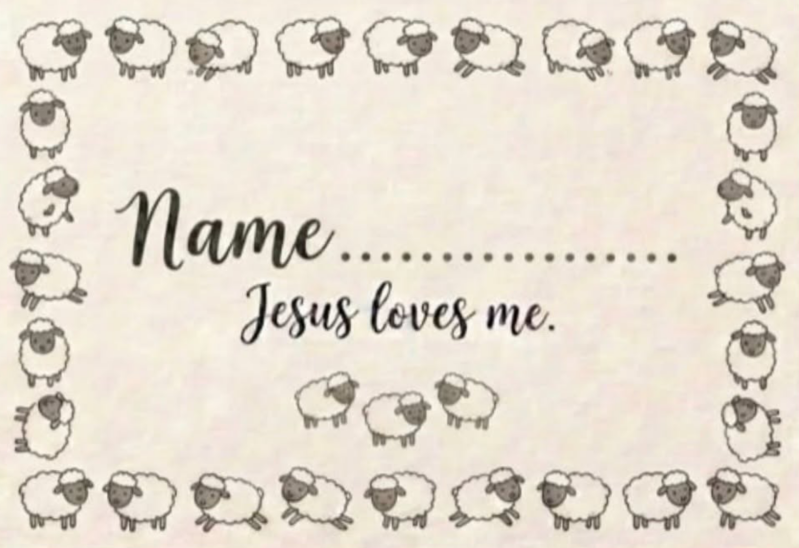
11. If you can, print out some name cards (like the one in the picture below). Write each person's name on one of the cards. One by one, call each person by name to come to you and give them their card. Tell them, one by one, "Jesus loves you and wants to be your shepherd."
__________________________________________________________
Answer to question 4. Analysing. Jesus was speaking about people from everywhere in the world who would later come to believe in Him, not just the people in Israel where He lived. You can read more about how this happened in the book of Acts in the New Testament.
Bible verses that tell us why Jesus died and rose again...
Romans 4:25 - 'God let people kill Jesus on the cross because of the wrong things that we have done. Then God raised Jesus from death, to show that he would accept us as right with Him.'
1 Corinthians 15: 3, 4 - 'Christ died as a sacrifice for our sins. The Bible already said how that would happen. People buried his dead body. On the third day after that, God raised Him up to live again.'
Create Your Own Website With Webador